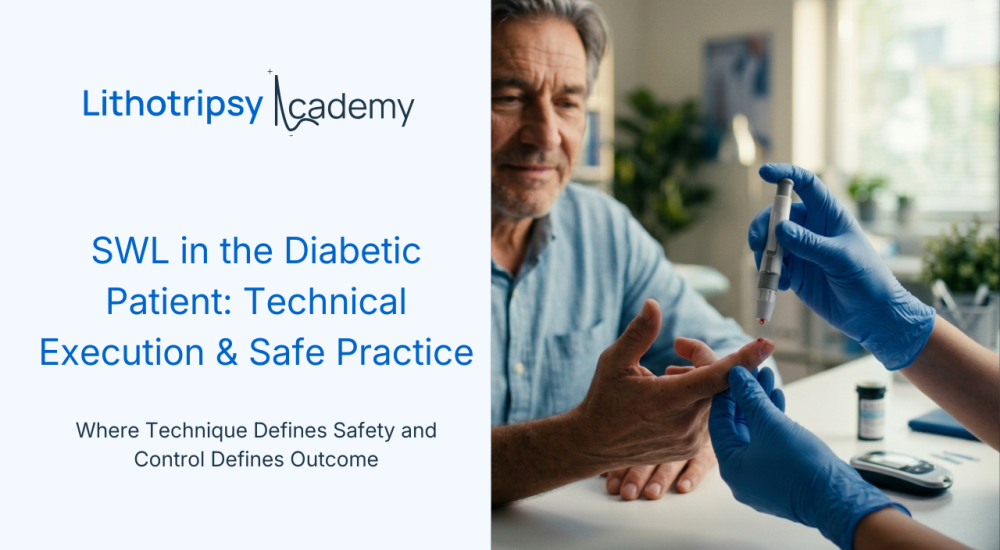
Managing kidney stones in diabetic patients requires more than standard shockwave lithotripsy techniques. Diabetes alters stone composition, increases infection risk, and affects renal tissue response—making treatment decisions and execution more complex.
This course, “SWL in the Diabetic Patient: Technical Execution & Safe Practice,” is designed to provide a structured, clinically grounded approach for lithotripsy operators and junior urologists. It focuses on the technical nuances of performing ESWL in diabetic patients, while integrating evidence-based insights from contemporary urological literature.
Participants will learn how diabetes influences uric acid stone formation, why these stones are often radiolucent, and how this impacts targeting strategies using ultrasound and fluoroscopy. The course also emphasizes the importance of pre-treatment infection screening, including urine culture and dipstick testing, as well as the role of glycemic control and renal function assessment in patient selection.
A key strength of this course is its practical focus on intra-procedural modifications, including structured ramping, energy control, shockwave rate optimization, and safe shock delivery limits. Special attention is given to complications such as infection and renal hematoma, with a clear distinction between clinically significant and self-limiting findings—helping operators maintain confidence without unnecessary alarm.
By the end of this course, learners will be able to apply a safe, controlled, and evidence-informed ESWL protocol tailored to diabetic patients, improving both treatment outcomes and patient safety.
Topics of Course
-
Biology of stone in Diabetes
01:18
-
Pre-Treatment Protocol
02:19
-
Intra-Treatment Protocol
01:41
-
Post-Treatment Protocol
00:31
Your Instructor
Lithotripsy Academy is a dedicated educational platform focused on advancing knowledge and clinical practice in shockwave lithotripsy and urolithiasis management.
All courses on this platform are conceptualized, structured, and designed by Dr. Sameer Parmar, with over two decades of experience in shockwave lithotripsy. His work is centered on translating clinical experience, scientific evidence, and real-world practice into structured, practical learning.
Select courses are further enriched through collaboration with invited international faculty, bringing diverse clinical perspectives and global expertise into the learning experience.
Each course reflects a carefully curated blend of evidence-based guidelines and expert clinical insight, ensuring that learners gain not only knowledge, but also a deeper understanding of decision-making in real-world practice.